Pre-Launch Specialty Pharmacy Selection is one of the most important commercial decisions you will make. This decision will determine how quickly patients access therapy, how smoothly prescribers navigate reimbursement, how much visibility you have into your own data, and how your brand is experienced in the market from day one. It influences gross-to-net performance, payer dynamics, operational scalability, and compliance exposure.
Once contracts are signed and workflows are built, changing course becomes complex, disruptive, and highly visible.
The good news? With the right strategic alignment and disciplined implementation, this decision can become a powerful accelerant for launch success.
Start With Strategy:
Defining Your Pre-Launch Specialty Pharmacy Model
Before evaluating specialty pharmacies, issuing an RFP, or comparing infrastructure capabilities, manufacturers should align internally on five foundational questions. The answers will shape distribution structure, contracting posture, governance standards, and ultimately launch performance.
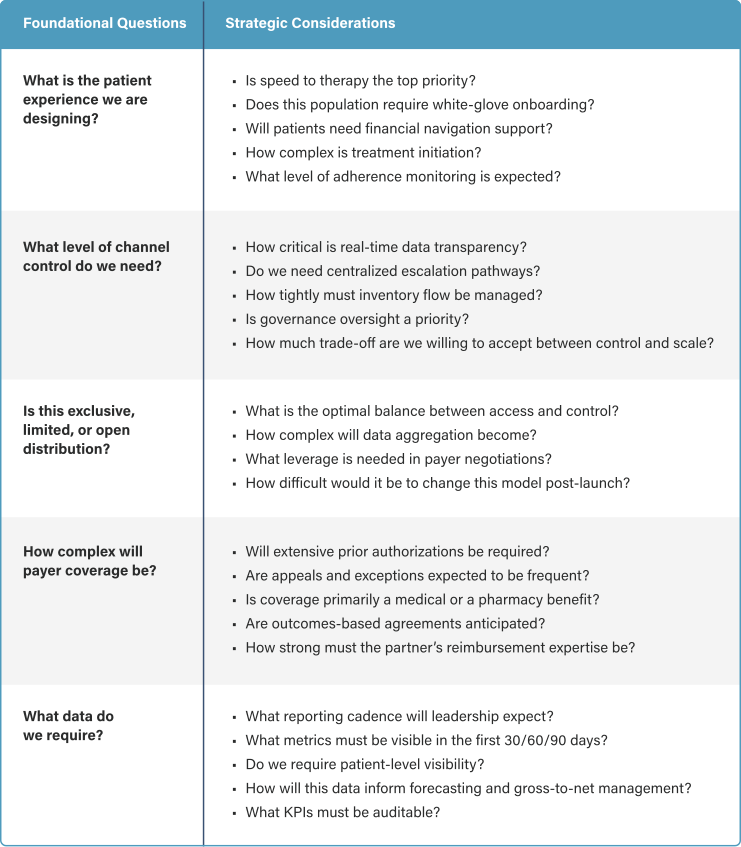
Without alignment on these questions, selection becomes reactive. The objective is not to choose the largest or most recognizable partner, but the one aligned with your commercial strategy and access environment.
Scale vs. Depth:
Choosing the Right Specialty Pharmacy Model
Large national specialty pharmacies offer infrastructure, established payer relationships, geographic reach, and operational capacity. Their integration with major PBMs can streamline access and support scalability.
Mid-sized or niche pharmacies often bring therapy expertise, operational agility, and closer manufacturer alignment. In targeted markets, that depth can strengthen onboarding and issue resolution.
The right model depends on the realities of the product and the access landscape.
Several critical factors must be evaluated, like:
 SITE OF CARE
 Site of care is often the first structural decision. Whether therapy is dispensed through specialty pharmacy, administered under buy-and-bill, or structured as a hybrid model fundamentally changes reimbursement flow, operational coordination, and financial visibility. Misalignment here creates downstream friction in access and volatility in forecasting.
 Patient population and geography
 A geographically dispersed population often benefits from infrastructure scale, standardized workflows, and broad regional coverage to ensure consistent access. In contrast, a concentrated referral base — where a limited number of treatment centers manage a meaningful share of patients — may require deeper coordination, tighter communication loops, and case-level engagement. The optimal model should reflect how patients enter the system, how referrals concentrate, and the level of operational collaboration those referral sources will demand.
 Complexity of treatment and onboarding
 If initiation involves extensive education, financial coordination, clinical checkpoints, or ongoing monitoring, deeper engagement and case-level management may be critical to protect conversion and adherence. In contrast, therapies with more standardized onboarding pathways may benefit from infrastructure scale and high-throughput efficiency. The partner model should reflect not just how many patients you expect, but how much work each patient requires.
 Product requirements
 Product requirements, including storage conditions, cold chain logistics, shipping windows, or chain-of-custody controls — should meaningfully shape partner selection. Therapies with highly specialized handling needs or narrow delivery parameters often require tighter operational coordination and focused execution. Products with more standardized distribution requirements may align well with broader infrastructure and established logistics networks.
 REMS requirements
 REMS requirements add another layer of compliance considerations. If a Risk Evaluation and Mitigation Strategy is involved, the pharmacy must be equipped to manage certification processes, monitoring obligations, documentation standards, and ongoing communication without creating unnecessary friction. Excess administrative burden can slow prescribing and delay initiation. The operational model should support seamless REMS execution, preserving compliance integrity and provider confidence at launch.
 Payer coverage difficulty
 Payer coverage difficulty should heavily influence the model. If coverage is relatively straightforward, infrastructure and payer reach may drive efficiency. If prior authorizations, appeals, or exceptions are expected, reimbursement expertise and case-level management depth may outweigh network size.
Misalignment introduces friction, such as slower time to therapy, increased operational escalations, and unnecessary strain on providers and internal teams. Alignment, by contrast, stabilizes the launch environment and allows access processes to perform as intended from day one.
The scale-versus-depth decision is not about choosing the largest or most specialized partner, but selecting the one whose strengths match the clinical, operational, and reimbursement realities of your launch.
Defining KPIs Before Contracting
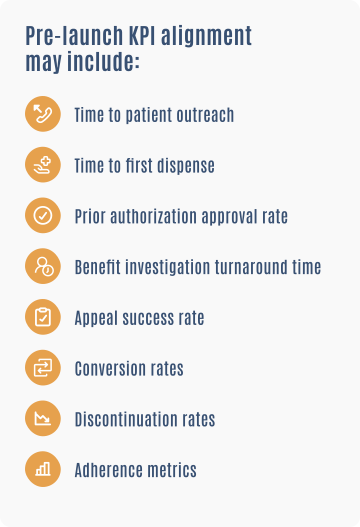
Performance expectations should be defined before contracts are signed. Aligning on KPIs during the pre-launch phase establishes clear standards, transparency, and accountability. When metrics are introduced after launch, performance discussions become reactive and more difficult to manage.
These metrics influence commercial performance. Time to first dispense affects early revenue flow. Conversion and discontinuation rates shape forecast accuracy. Appeal success impacts provider confidence. Adherence influences long-term brand durability.
Contracts should reinforce these expectations. Agreements should define service level guarantees, KPI thresholds, reporting cadence, data accuracy standards, inventory management expectations, and clearly structured exit clauses. Performance language must be measurable. Data requirements should specify format, timeliness, and frequency. Exit provisions should preserve flexibility if performance does not meet agreed standards.
Defining performance and contractual accountability at the same time protects the launch from preventable volatility.
Specialty Pharmacy Selection Criteria
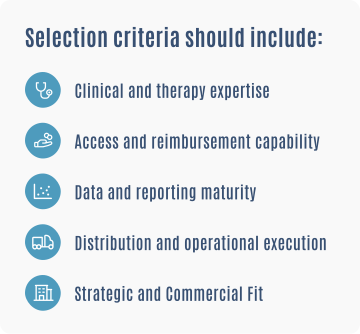
Selecting specialty pharmacies requires a structured evaluation framework. Infrastructure scale alone does not determine alignment with a launch strategy.
Clinical expertise influences onboarding and provider support. Reimbursement capability affects time to therapy and coverage navigation. Data maturity supports more precise forecasting and oversight. Operational execution protects product integrity and inventory stability. The partnership model determines governance alignment and long-term responsiveness.
A disciplined RFI or RFP process supported by cross-functional scoring strengthens decision quality. The objective is alignment between the partner’s capability and the product’s clinical, operational, and reimbursement realities.
Turning Strategy Into Execution
The implementation phase is where launch readiness is validated. Selecting a specialty pharmacy partner is only half of the work. True readiness requires structured pressure testing before the first prescription is written.
Effective pre-launch implementation begins with a disciplined process and timeline. Weekly governance workstreams create alignment between manufacturer and specialty pharmacy teams, ensuring teams are trained operationally and clinically, adherence programs are developed, and integration with the patient services hub is aligned, clearly defining who does what. Without consistent governance, early friction can escalate quickly.
Mock patient journey testing, conducted in coordination with the patient services hub, allows teams to simulate real-world referral, benefit investigation, prior authorization, and dispensing workflows. These simulations expose operational gaps while there is still time to correct them. Pressure testing in advance reduces volatility once the product is live.
Escalation pathway mapping is equally important. Clear ownership, defined resolution timelines, and documented communication channels prevent access issues from lingering. When escalation processes are undefined, delays compound and provider confidence erodes.
Care team training must also align with brand positioning and patient experience expectations. The specialty pharmacy team frequently becomes a primary operational touchpoint for patients and providers. Alignment at this level influences how the therapy is experienced in the market.
Specialty pharmacy is not simply a distribution decision. It is a commercial strategy lever. When selected and implemented with discipline, it accelerates patient access, stabilizes early launch performance, and strengthens prescriber trust.
Connect with our experts today!
At Two Labs, we partner with manufacturers across channel strategy, specialty pharmacy evaluation, structured selection, and implementation governance. Our focus is to ensure that strategic decisions translate into operational readiness and measurable commercial performance.
If you are preparing for a specialty launch and evaluating your distribution and specialty pharmacy strategy, Two Labs welcomes the opportunity to connect, share perspectives, and help define and implement a model that meets the needs of patients, prescribers, payers, and the manufacturer.