
Bringing a drug to market is a significant milestone, marking the culmination of years of clinical development, regulatory planning, and cross-functional coordination, all converging in a single moment: launch day.
While launch is a significant achievement, it does not guarantee immediate commercial success. Once a product enters the market, strategies are tested by real-world conditions that often challenge initial assumptions. Demand may differ from forecasts, inventory can become misaligned, and payer or access barriers may delay patient uptake. These post-launch dynamics offer the first clear view of product performance across distribution, reimbursement, and patient access.
A strong launch plan alone does not ensure sustained success. As these conditions unfold, gaps between strategy and execution emerge, affecting access, channel performance, and commercial outcomes. Organizations that identify and address these gaps early, while aligning trade, distribution, and operational execution, are better positioned for ongoing performance and reliable patient access.
The Shift from Launch Readiness
to Commercial Performance
Pre-launch planning is designed to create a controlled and predictable model. Teams define distribution strategy, establish trade agreements, and align operational processes based on expected demand and channel behavior.
After launch, that model becomes dynamic and interdependent. Performance is no longer driven by planning assumptions, but by how the system operates under real conditions.
Several factors begin to reshape performance:
- Real-world demand patterns that change from forecasts
- Variability in channel performance across wholesalers, specialty distributors, and pharmacies
- Evolving payer and provider dynamics that influence access and reimbursement
- Operational strain as volume scales across distribution and fulfillment networks
- New competition, new indications, and changes in the route of administration
These factors introduce variability across the commercial model. Inventory can fall out of sync with demand, order flow becomes less predictable, and coordination with wholesalers, distributors, and pharmacy partners grows more difficult.
Organizations that perform well in this phase recognize that commercialization is not a fixed model. It is a system that requires continuous evaluation and adjustment and where performance depends on how effectively strategy, operations and execution remain aligned as conditions evolve.
Why Post-Launch Optimization Matters
If post-launch optimization is not actively managed, gaps in execution can quickly translate into measurable commercial impact. Misalignment across trade and distribution can raise costs, erode margins, and reduce efficiency. Poor inventory positioning can create imbalances or product delays, while gaps across partners can slow patient access and create inconsistent provider experiences.
These are not isolated operational challenges. They directly affect:
- Revenue realization and financial performance
- Patient access and therapy adoption
- Channel efficiency and partner performance
By treating post-launch as a performance management discipline, organizations can proactively monitor results, adjust strategies based on data, and improve their ability to achieve long-term success.
Where Post-Launch Optimization Breaks Down
Even well-designed commercial models encounter friction once exposed to real-world conditions. Across manufacturers, four consistent pressure points emerge.
1. Trade Strategy vs. Real Utilization
Teams design trade strategies to balance compliance, operational efficiency, and commercial impact, but those strategies rely on assumptions that rarely hold up in the real world. Demand patterns, ordering behavior, and channel dynamics rarely align perfectly with pre-launch expectations.
As a result, contracts that appeared well-structured before launch need to be revisited at various times to ensure the assumptions used still hold true, such as:
- Actual product velocity
- Service expectations across partners
- Channel economics and cost-to-serve
Leading organizations actively manage these agreements as performance evolves. This includes evaluating:
- Distribution service agreements (DSAs)
- Administrative and data fees
- Chargebacks and inventory terms
- Performance expectations tied to measurable KPIs
They translate contract structures into governance frameworks that ensure accountability across partners.
Without this level of oversight, misalignment can increase cost-to-serve, introduce financial risk, and weaken channel performance over time.
2. Operational Models Under Scale
Processes designed for launch often struggle as demand grows and complexity increases. This typically introduces pressure on the following areas:
- Order management workflows and routing logic
- Allocation strategies across distributors and sites of care
- Coordination between internal teams, 3PLs, and external partners
- SP performance during product ramp and thereafter
- HUB coordination with SPs
- Class of Trade execution and strategy alignment
If not addressed, these challenges can disrupt supply, delay fulfillment, and create inconsistent experiences for providers and patients.
3. Turning Data into Performance
Post-launch environments generate significant volumes of data, but data alone does not improve performance. In many organizations, insights remain fragmented across stakeholders, delayed, and disconnected from execution.
Manufacturers often have access to critical inputs, including:
- Distributor inventory and fulfillment data
- Order patterns and channel demand signals
- Dispense and patient status data
However, without integration and clear ownership, this information remains underutilized. Teams lack a unified view of performance, making it difficult to identify issues early or act with precision.
High-performing organizations take a different approach. They operationalize data by:
- Integrating insights across trade, distribution, and operations
- Identifying bottlenecks earlier in the process
- Using data to refine channel strategy and improve partner performance
By connecting data directly to execution, these organizations enable faster decision-making, reduce reactive issue management, and improve overall commercial performance.
4. Lifecycle Strategy Comes Too Late
Many organizations treat post-launch optimization as a short-term effort, but performance continues to evolve across the full product lifecycle. As products approach loss of exclusivity, new challenges emerge that require proactive planning.
These shifts often include:
- Changes in demand and ordering behavior
- Increased competitive pressure
- Margin compression
- The need to restructure distribution channels due to new competition, LOE, MFP, and payer impact
Organizations that delay these transitions limit their ability to respond effectively when conditions change. By the time adjustments begin, channel dynamics and pricing pressures have already shifted.
In contrast, organizations that plan early can proactively adjust their distribution strategy, inventory management approaches, contracting structures, and pricing and rebating strategies.
Lifecycle strategy should not be considered in later stages. Rather, it should be a continuation of post-launch optimization that requires early and deliberate planning.
Turning Strategy into Results
Even when organizations recognize post-launch challenges, many struggle to implement a coordinated response. Trade, distribution, operations, and data are often managed in silos, creating gaps between strategy and execution.
This fragmentation leads to:
- Delayed response to emerging issues
- Inconsistent performance across partners and channels
- Limited visibility into how the commercial model is performing in real time
As a result, well-designed strategies fail to translate into consistent outcomes once exposed to real-world conditions.
Organizations that sustain commercial success treat post-launch as a continuous performance management system, focusing on aligning execution across all components of the commercial model. They consistently:
- Evaluate distribution performance and partner effectiveness
- Align trade strategy with real-world utilization and channel economics
- Adapt operations as demand and access dynamics evolve
- Use integrated data to guide decision-making
- Plan for lifecycle transitions well in advance
Most importantly, they connect these functions. Trade, distribution, operations, and data operate as a coordinated system rather than independent workstreams. Organizations that connect strategy to execution gain greater control over performance, enabling faster decision-making, more consistent access, and stronger commercial outcomes over time.
How Two Labs Supports Post-Launch Optimization
Post-launch optimization requires more than visibility; it requires the ability to connect strategy to execution across trade, distribution, operations, and compliance.
Two Labs partners with manufacturers to help organizations move beyond reactive issue management by building integrated, performance-driven post-launch strategies that evolve with the market. This includes:
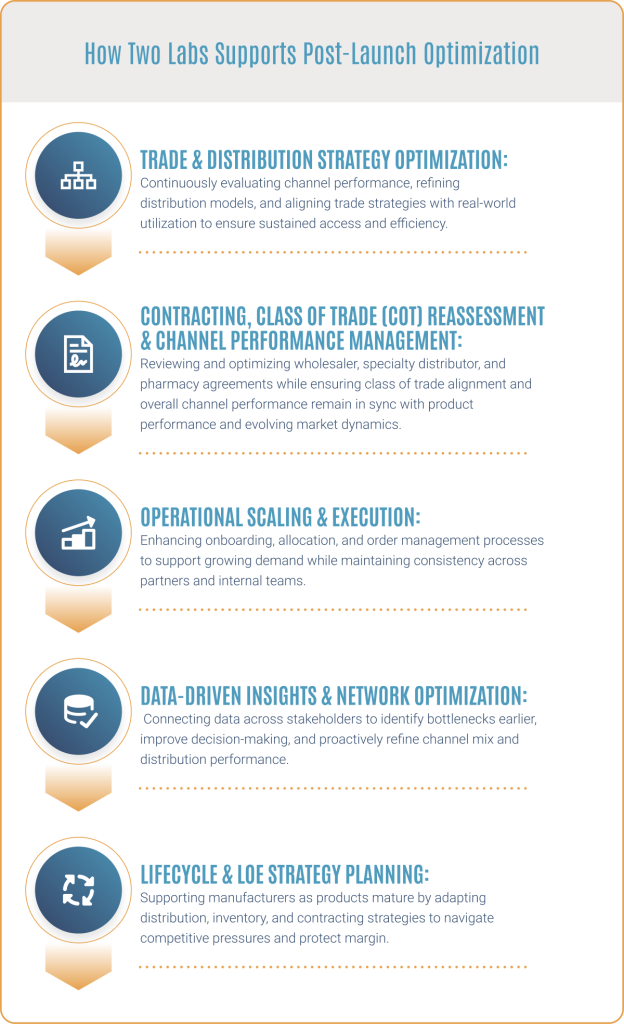
Two Labs brings a unique ability to bridge strategy and execution, working across internal teams and external partners to ensure post-launch plans perform with vigor.
Connect with our experts today!
At Two Labs, we partner with manufacturers across channel strategy, specialty pharmacy evaluation, structured selection, and implementation governance. Our focus is to ensure that strategic decisions translate into operational readiness and measurable commercial performance.
If you are preparing for a specialty launch and evaluating your distribution and specialty pharmacy strategy, Two Labs welcomes the opportunity to connect, share perspectives, and help define and implement a model that meets the needs of patients, prescribers, payers, and the manufacturer.